Qinavyuk’s Rural Development Journey: RD Capstone Synthesizing Paper Excerpt

By Dana Diehl, 2026 RD MA Graduate. Dana completed RD 691 Seminar in Rural, Community, and Indigenous Development Issues in the spring.
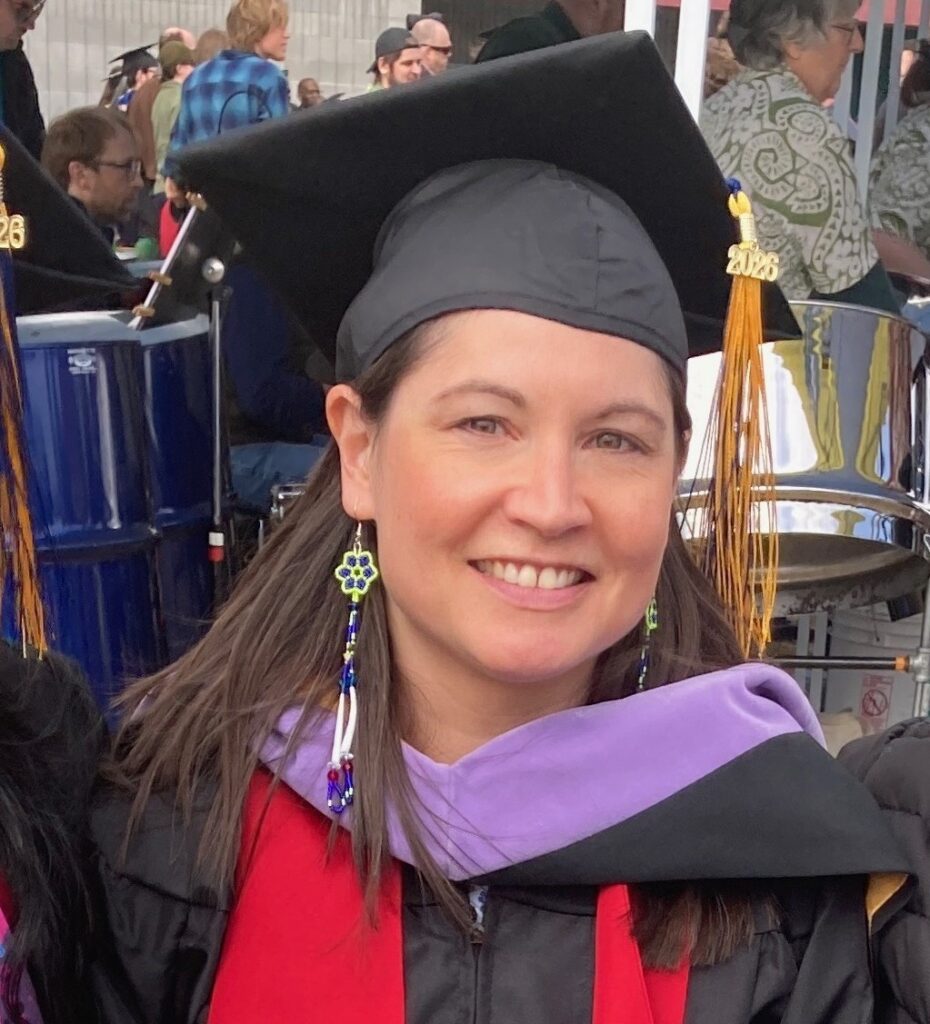
Author Dana Diehl smiling at her 2026 graduation ceremony, wearing a black mortarboard with a gold '2026' tassel, black graduation gown, lavender master's hood, red Alaska Native heritage sash, and beaded earrings. A drum kit and crowd are visible in the background.
Author Dana Diehl at the 2026 UAF graduation ceremony.

Dana’s Final RD Portfolio

Introduction

Yagheli du? Alexandria Bobby schida ghila, Fritz Donhauser schada’a ghila. Emma Diehl schida ghila, Richard Diehl schada’a ghila. Esther Diehl shuntda nlan, Dave Diehl shtutda nlan. Qinavyuk or Dana sh’izhi qilan. Yupik and Dena’ina eshlan shida. Aniak shugu shqayeh qilan da. Q’udi Nukelehitnu shugu yeshdu da. Michael Martz shqen nlan. Chin’an.

Is it good? My maternal grandmother was Alexandria Bobby, my maternal grandfather was Fritz Donhauser. My paternal grandmother was Emma Diehl, my paternal grandfather was Richard Diehl. My mother is Esther Diehl, my father is Dave Diehl. My name is Qinavyuk or Dana. I really am Yupik and Dena’ina. My village is Aniak. Now I live in Eagle River. My husband is Michael Martz. Thank you.

I chose to start my final synthesizing paper with my written Dena’ina introduction because a significant part of my growth throughout the Rural Development program has been connecting to who I am as a Dena’ina person and learning my introduction in the Inland Dena’ina dialect. Throughout the paper, I discussed the key concepts of Indigenous Leadership, self-determination, praxis and community-based development assets and I end with my rural development model and how I plan to continue applying these concepts to my personal, professional and academic growth.

My Rural Development Model

The concepts of Indigenous leadership, self-determination, praxis and community-based development assets create the foundation to my rural development model. I use a birch tree in Figure 1 as a metaphor for this model. The roots of the tree represent how the core values of Indigeneity (relationality, responsibility, reciprocity and redistribution) will keep me grounded and true to who I am as a Yupik and Dena’ina woman from a rural community.
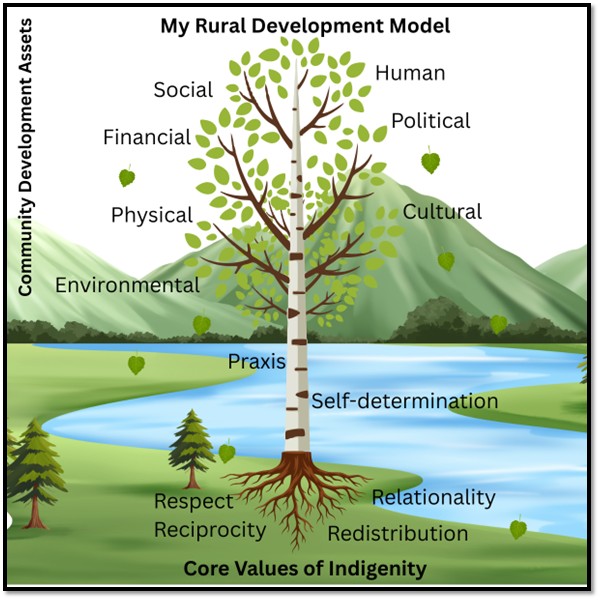
A conceptual diagram depicting a birch tree set against a rural landscape with mountains, a river, and forest. The diagram is divided into two sections by the ground line.
Above ground — labeled "Community Development Assets": The tree's branches and leaves are labeled with seven asset categories: Social, Human, Financial, Political, Physical, Cultural, and Environmental.
Along the trunk — connecting roots to branches: Two bridging concepts are labeled on the trunk: Praxis and Self-determination, representing the link between the core values and the community development assets.
Below ground — labeled "Core Values of Indigeneity": The tree's root system is labeled with four core values: Respect, Reciprocity, Relationality, and Redistribution.
The tree serves as a visual metaphor where Indigenous core values (roots) connect through Praxis and Self-determination (trunk) to support community development assets (branches), within a rural development framework.
Dana’s Rural Development Model connecting the core values of Indigeneity to community development assets through the concepts of praxis and self-determination. Developed using a personal photo and providing prompts in Canva AI. 4/27/26.  

            Harris and Wasilewski (2004) define relationship as the sense that humans are related to each other and all things including animals, plants, rocks, and all creation. Responsibility reminds us that we have a responsibility to care for all of our relatives. Reciprocity is the understanding that in nature things are circular, based on relational dynamics and seen as ‘kin’ to each other. Redistribution is the sharing obligation including redistribution of material and social goods to keep everything in circulation. What these core values mean to me in the context of my rural development model is that regardless of what job I have and what community I live in, as an Indigenous leader I am always accountable to the people, our ancestors, the land, and all living things, and I have a responsibility to take good care of human and non-human things, to give back in material and non-material ways, and to respect all things. These core values align with the Dena’ina values my mother instilled in me. She specifically taught us to respect all things, take care of each other, and to share. Although these values have been instilled in me since childhood, I understand that to actively live them and keep my roots grounded, I have a responsibility to intentionally practice them every day.

            The trunk of the tree represents self-determination and praxis. I chose the trunk because the trunk is what creates a framework and a connection between the roots and the branches (community-development assets). In order to make meaningful changes in a community, it is my responsibility to use the framework of praxis in a way that is rooted in self-determination. When the trunk of the tree sways one way or another, and encounters threats, self-determination will ensure I stay committed to responding to the needs of the community, protect it from outside influences by advocating for what is right, and remember that what we do is bound together in one unity of action.

            The branches of the tree represent community-development assets including physical, human, social, financial, environmental, political and cultural. In order for the branches to have leaves that bloom every season, the community needs support from the roots, the trunk and the branches to help the tree capitalize on the assets of the community. For example, a leaf might represent culture as a community-based asset. When the community sustains an initiative to support its culture, the leaf is healthy and in full bloom. When the leaves drop in the fall, it is a representation that the rural development model is cyclical and that continued investment into its assets will ensure future sustainability. The leaves also represent the importance of balance and how focusing on multiple assets in a community, not just one will keep the tree healthy and thriving.

Conclusion

As I reflect on my journey through the Masters in Rural Development Program including my original statement of interest to enter the program in 2021, I feel fortunate to have enhanced my understanding of various key concepts but especially Indigenous leadership, self-determination, praxis and community-development assets. My goal at the time of entering the program was to enhance my understanding of how to support the health and economic well-being of rural, Alaska Native communities while staying true to our values as Alaska Native people. Each class has helped me work towards achieving this goal and I am especially grateful for the emphasis on rural, Indigenous communities and the cultural relevancy of the program. I have been able to apply much of what I learned in all aspects of my life, especially at work.

Another benefit of completing this program is that I have gained confidence in my abilities as a leader and feel that I am more equipped today to advocate for the self-governance of Alaska Native people and our Tribal organizations, and to participate in meaningful decision making as described in the UNDRIP definition of self-determination. As I move into the next phase of my rural development journey, I plan to take these key concepts with me as I strive to be an Indigenous leader that stays rooted in my core values of Indigeneity. Chin’an, thank you to all of my professors, classmates, family and friends that have supported me along the way.

Reference

Harris, L.D. and Wasilewski, J. 2004. Indigeneity, an alternative worldview: four R’s (relationship, responsibility, reciprocity, redistribution) vs. two P’s (power and profit). Sharing the journey towards conscious evolution. Syst. Res., 21: 489-503. https://doi.org/10.1002/sres.631
Rural Development Capstone: RD 691 Seminar in Rural, Community, and Indigenous Development Issues

Many rural development graduate students have worked for years in rural development contexts. For others, the program may be some of their first encounters with the principles and practices of rural and community development. In either case, when rural development M.A. students graduate from the program they formally enter the role of rural development practitioner. Since 2022 the rural development master’s program has included a capstone course where both research and non-research pathway students review key concepts from the core courses in the M.A. program and develop a graduate portfolio illustrating their application in rural development contexts. A key part of the course is creating a synthesizing paper or video that connects the key concepts of rural development with their work and lives, develops a model for rural development practice, and examines how they might apply this model to their future work.

The design of this course is intended to function as a review and synthesis of rural development key concepts, but it is also designed to embrace students unique perspectives and strengths, especially around how knowledge is created and shared. For that reason, students are allowed to choose how they present their knowledge and experience – through websites, traditional papers, videos, or other formats. Every year we discover new creative opportunities and new challenges. This year, with their permission, we are highlighting the work of some of our RD MA graduates.

DANSRD congratulates ANS graduate Sharon Hildebrand: by Jenny Bell Jones

DANSRD would like to congratulate ANS graduate Sharon Hildebrand on her election as Vice President of Tanana Chiefs Conference.  Sharon is a 2013 graduate from our program who then continued her education and earned a Master’s of Public Administration from UAS in 2018. She was a stellar student who refused to let numerous challenges prevent her from reaching her educational goals.

Sharon is originally from Nulato but has made Fairbanks her home with her husband and sons where we are lucky to be able to call them neighbors. She is currently employed by Doyon Limited as their Village Outreach Liaison.

She has an exemplary record of public service and leadership and currently serves on the Board of Fairbanks Native Association in addition to her new position with TCC. She has been involved with youth hockey in Fairbanks and has raised her sons to be hard working respectful young men that we can all be proud of. She has been involved with the Fairbanks North Star Borough School District as a curriculum review committee member and she is active with Big Brothers Big Sisters of America. She serves on her Village Corporation Board of Directors and as a board member for Get out the Native Vote. She has a passion for singing Denakka songs of Nulato & Kaltag and is a strong advocate for the Indigenous languages. She is active with the Denakkanaaga Elders organization … and these are just the major highlights.

Sharon took the tools that both traditional and western education gave her and used them for the benefit of so many. We wish her all the best and when anyone asks where they might go with an ANS degree I will tell them to look no further than Sharon and do their best to follow in her shoes. She has provided a fine example for all to follow.   

RD BA graduate Nicholes on how DANSRD prepared him for international graduate school success

At the end of Spring 2022, I will submit my graduate thesis on social movements and cultural trauma as part of the Human Security Master’s Program at Aarhus University in Denmark. Five years ago, I could not have imagined myself nearing the completion of a graduate degree or even the type of person applying to doctoral programs. Academia, in general, was outside anything I could really have imagined. All of this taken into consideration — I can only give gratitude for what feels like an endless number of people willing to put in the effort supporting me throughout my academic career. A significant amount of that effort rests with the excellent faculty and staff at the Department of Alaska Native Studies and Rural Development.

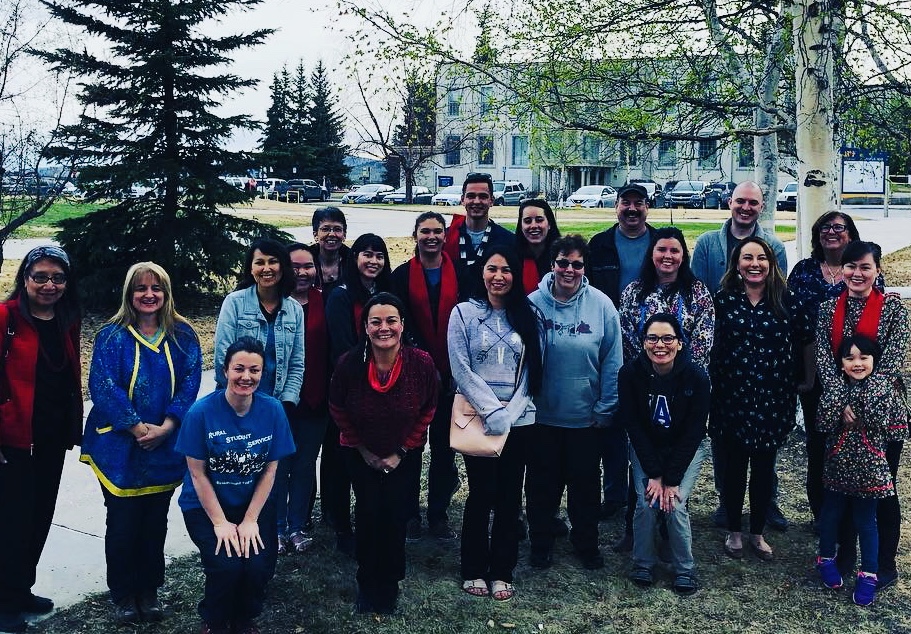
Nicholes (back row, second from the right) with DANSRD faculty, staff, and fellow graduates, May 2019.

I first began my studies in the Rural Development Bachelor of Arts program at the University of Alaska Fairbanks in 2017, leaving my home in Seattle and heading north to Alaska. I was nervous and excited about my transition to Alaska as anyone will be when taking the leap to somewhere new. I should not have worried in the least however, as the support I received from my professors and staff was fantastic from day one. All my needs as I settled into my new home were met without issue and the university environment was undoubtedly one of the most welcoming I had ever experienced. Once my studies began, I found that the topics covered were comprehensive in scope and intensive in their depth. The Rural Development program covered topics ranging from law, public policy, project development, environmental crises, history, ethics, business planning, and human development theory.

Following my UAF graduation, I applied and was accepted into Aarhus University in 2020. One more move taking me further and farther than I had been on my own. Surprisingly, I found little to no issues adapting to postgraduate education. My Rural Development degree had prepared me. Frankly, I should have realized that fact from the first class I ever took at UAF, Rural Alaska Land Issues. I still remember the first day and walking into Professor Kathleen Meckel’s class — Not only one of the most welcoming professors I ever had the opportunity to meet, but also an excellent guide into what would be an entire semester covering Alaskan land laws and policy. There was never a separation between what I studied and how it impacted Alaska, which helped me develop a skill set used throughout my master’s program today — particularly in research.

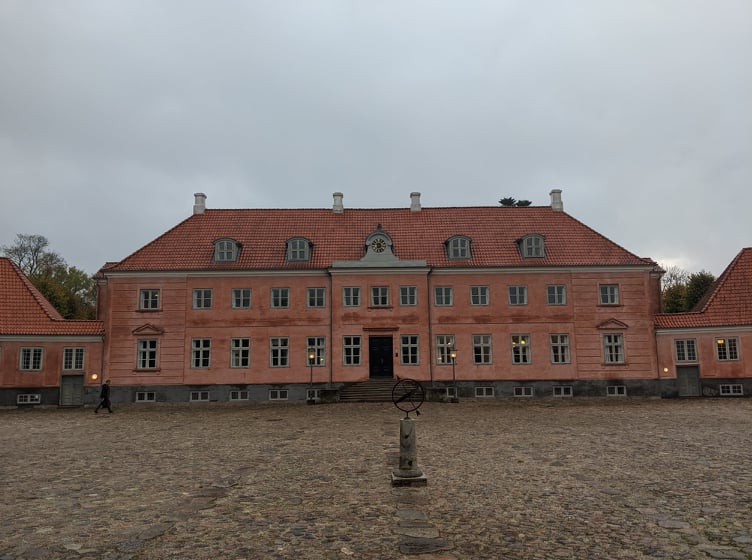
Moesgaard Campus (MOCA) where the Anthropology, Human Security, Archaeology and Sustainable Heritage Management Programs are held at Aarhus University.

On the practical side, I also learned various skills essential to anyone’s academic career. I learned how to produce written work and deliverables at the postgraduate level. More than that, I was given a practical education on project design, presentation, grant writing, and research development that I had never learned outside of university. When diving into our final semester, I received in-depth support on developing a thesis and research methods while covering criticism and theoretical developments in research methodology.  At the end of the program, I felt more than capable of discussing theory with my professors, covering figures like Amartya Sen and Paulo Freire, depopulation theory, and many others. I also found myself throughout the program learning through discussions with my classmates and peers as the diverse cohort I studied with all had experiences reached outside the classroom. Even though my studies in the master’s program have shifted their focus outside of the Alaskan context, I still find my research revolving around many of the same topics I studied in the Rural Development program. Issues of inequality, ecological crises, food scarcity, public policy, and law are not only limited to Alaska. Additionally, the focus in Alaska didn’t restrict me in the least; Instead, it allowed me to delve deeper into the topics at hand around real issues felt in the region. Ultimately, as a master’s student, research and my thesis are the final goals; I would have been on a less sure path if not for the Rural Development program and everyone involved.

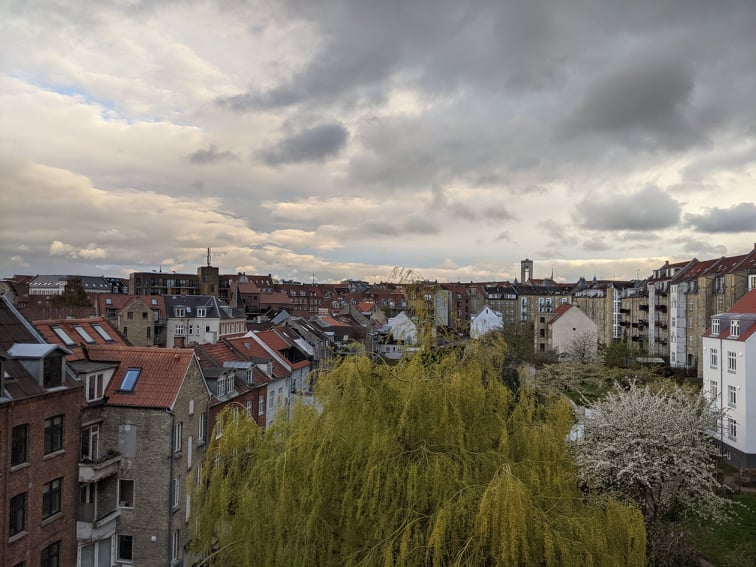
Rooftop view of Aarhus, Denmark.