By Dana Diehl, 2026 RD MA Graduate. Dana completed RD 691 Seminar in Rural, Community, and Indigenous Development Issues in the spring.
Introduction
Yagheli du? Alexandria Bobby schida ghila, Fritz Donhauser schada’a ghila. Emma Diehl schida ghila, Richard Diehl schada’a ghila. Esther Diehl shuntda nlan, Dave Diehl shtutda nlan. Qinavyuk or Dana sh’izhi qilan. Yupik and Dena’ina eshlan shida. Aniak shugu shqayeh qilan da. Q’udi Nukelehitnu shugu yeshdu da. Michael Martz shqen nlan. Chin’an.
Is it good? My maternal grandmother was Alexandria Bobby, my maternal grandfather was Fritz Donhauser. My paternal grandmother was Emma Diehl, my paternal grandfather was Richard Diehl. My mother is Esther Diehl, my father is Dave Diehl. My name is Qinavyuk or Dana. I really am Yupik and Dena’ina. My village is Aniak. Now I live in Eagle River. My husband is Michael Martz. Thank you.
I chose to start my final synthesizing paper with my written Dena’ina introduction because a significant part of my growth throughout the Rural Development program has been connecting to who I am as a Dena’ina person and learning my introduction in the Inland Dena’ina dialect. Throughout the paper, I discussed the key concepts of Indigenous Leadership, self-determination, praxis and community-based development assets and I end with my rural development model and how I plan to continue applying these concepts to my personal, professional and academic growth.
My Rural Development Model
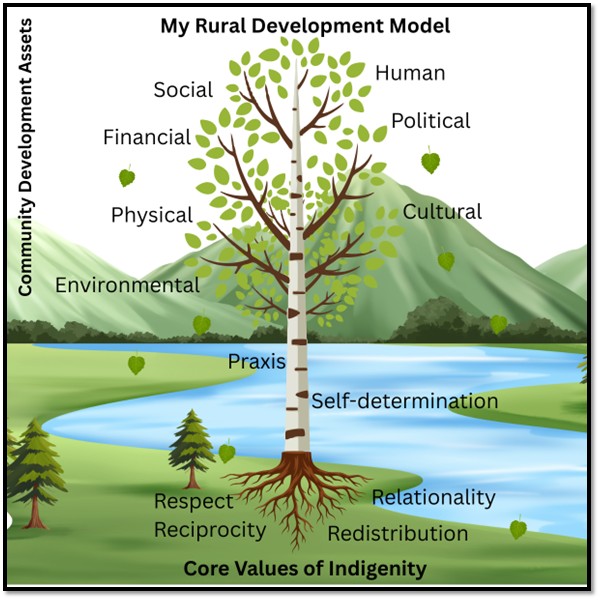
The concepts of Indigenous leadership, self-determination, praxis and community-based development assets create the foundation to my rural development model. I use a birch tree in Figure 1 as a metaphor for this model. The roots of the tree represent how the core values of Indigeneity (relationality, responsibility, reciprocity and redistribution) will keep me grounded and true to who I am as a Yupik and Dena’ina woman from a rural community.
Harris and Wasilewski (2004) define relationship as the sense that humans are related to each other and all things including animals, plants, rocks, and all creation. Responsibility reminds us that we have a responsibility to care for all of our relatives. Reciprocity is the understanding that in nature things are circular, based on relational dynamics and seen as ‘kin’ to each other. Redistribution is the sharing obligation including redistribution of material and social goods to keep everything in circulation. What these core values mean to me in the context of my rural development model is that regardless of what job I have and what community I live in, as an Indigenous leader I am always accountable to the people, our ancestors, the land, and all living things, and I have a responsibility to take good care of human and non-human things, to give back in material and non-material ways, and to respect all things. These core values align with the Dena’ina values my mother instilled in me. She specifically taught us to respect all things, take care of each other, and to share. Although these values have been instilled in me since childhood, I understand that to actively live them and keep my roots grounded, I have a responsibility to intentionally practice them every day.
The trunk of the tree represents self-determination and praxis. I chose the trunk because the trunk is what creates a framework and a connection between the roots and the branches (community-development assets). In order to make meaningful changes in a community, it is my responsibility to use the framework of praxis in a way that is rooted in self-determination. When the trunk of the tree sways one way or another, and encounters threats, self-determination will ensure I stay committed to responding to the needs of the community, protect it from outside influences by advocating for what is right, and remember that what we do is bound together in one unity of action.
The branches of the tree represent community-development assets including physical, human, social, financial, environmental, political and cultural. In order for the branches to have leaves that bloom every season, the community needs support from the roots, the trunk and the branches to help the tree capitalize on the assets of the community. For example, a leaf might represent culture as a community-based asset. When the community sustains an initiative to support its culture, the leaf is healthy and in full bloom. When the leaves drop in the fall, it is a representation that the rural development model is cyclical and that continued investment into its assets will ensure future sustainability. The leaves also represent the importance of balance and how focusing on multiple assets in a community, not just one will keep the tree healthy and thriving.
Conclusion
As I reflect on my journey through the Masters in Rural Development Program including my original statement of interest to enter the program in 2021, I feel fortunate to have enhanced my understanding of various key concepts but especially Indigenous leadership, self-determination, praxis and community-development assets. My goal at the time of entering the program was to enhance my understanding of how to support the health and economic well-being of rural, Alaska Native communities while staying true to our values as Alaska Native people. Each class has helped me work towards achieving this goal and I am especially grateful for the emphasis on rural, Indigenous communities and the cultural relevancy of the program. I have been able to apply much of what I learned in all aspects of my life, especially at work.
Another benefit of completing this program is that I have gained confidence in my abilities as a leader and feel that I am more equipped today to advocate for the self-governance of Alaska Native people and our Tribal organizations, and to participate in meaningful decision making as described in the UNDRIP definition of self-determination. As I move into the next phase of my rural development journey, I plan to take these key concepts with me as I strive to be an Indigenous leader that stays rooted in my core values of Indigeneity. Chin’an, thank you to all of my professors, classmates, family and friends that have supported me along the way.
Reference
Harris, L.D. and Wasilewski, J. 2004. Indigeneity, an alternative worldview: four R’s (relationship, responsibility, reciprocity, redistribution) vs. two P’s (power and profit). Sharing the journey towards conscious evolution. Syst. Res., 21: 489-503. https://doi.org/10.1002/sres.631